Editing the cockpit voice recording of the Hudson River landing
Close to Miracles
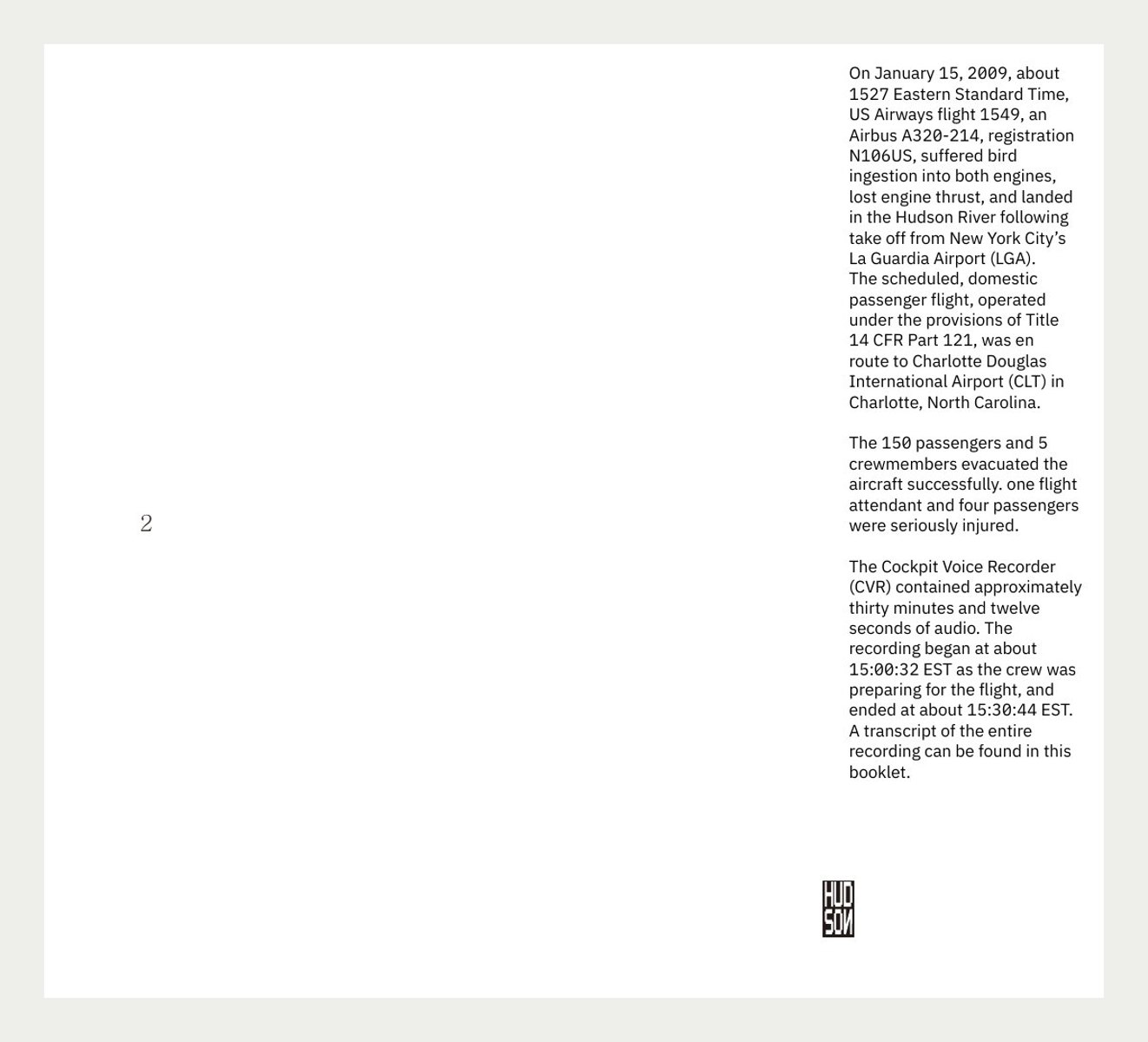
Summary
Not a word of the source changed; only how it reads. Timecodes became folios and channels became columns. Thirty minutes and twelve seconds of cockpit voice recording, set so the order you read it in is the order it happened. “It wasn't a miracle. It was a crew effort.”
- 32 pages
- 614×861mm
- 15:00:32 → 15:30:44
Overview
On 15 January 2009, US Airways Flight 1549 lost both engines to a bird strike shortly after take-off and landed on the Hudson River. All 150 passengers and 5 crew got out. The source text is the cockpit voice recorder transcript published by the US National Transportation Safety Board. The sentences stayed as they were; the structure was rebuilt.
The work
- The timecode is the folio – from 15:00:32 to 15:30:44, each page is numbered by the moment it holds. Turning a page is time passing.
- The channel is the column – inside the cockpit (HOT, CAM), radio traffic (RDO, INTR), automatic warnings (GPWS) and cabin announcements (PA) each get their own column, so who spoke to whom is visible before it is read.
- One typeface family – IBM Plex Mono for the transcript, IBM Plex Sans for titles and notes. Every utterance is set at the same width, so silence and overlapping speech become space.
- The same data as a book and as a poster – the entire transcript also sits on a single 614×861mm sheet. The book is read in sequence; the poster is seen whole.
Reflection
- Editing is interpretation. Without changing a sentence, what becomes a column and what becomes a folio decides how it is understood.
- The trade-off – the poster shows everything at once but is hard to read in order. The book is the opposite. That is why the same data exists as both.
- Left undone – a few working markers from the poster's automated typesetting are still in the file; a reprint starts by clearing those.